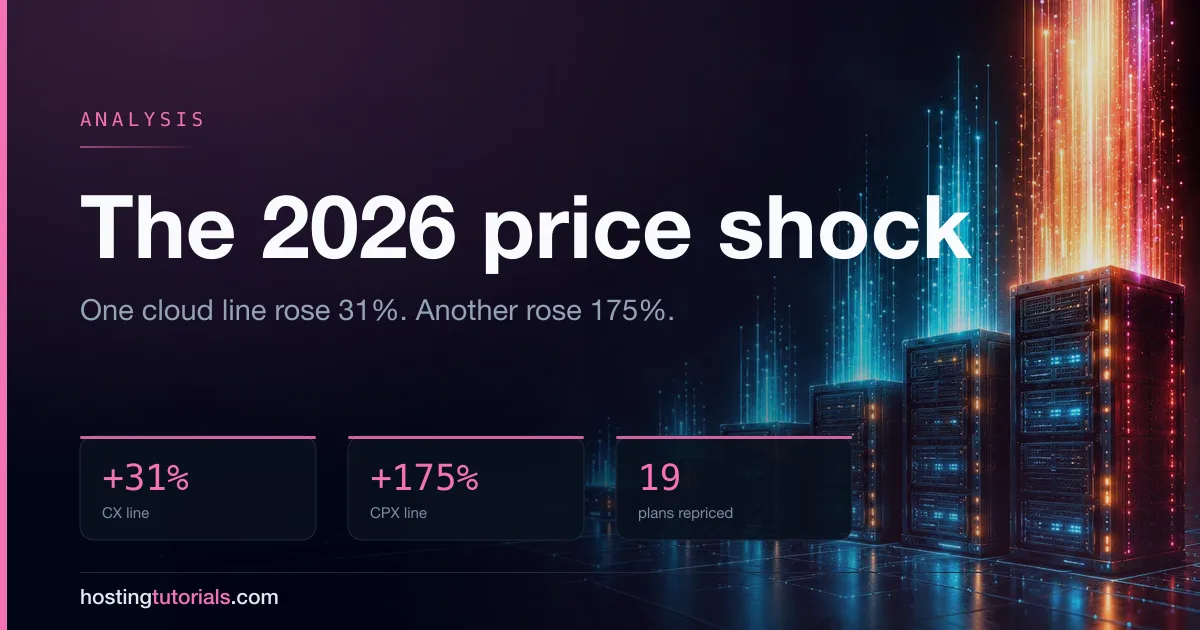
Your renewal quote is higher than last year's, and your provider is not the reason. Between autumn 2025 and this summer the contract price of server memory roughly tripled, and every hosting company in Europe passed part of that on. What the announcements do not say is that they did not pass it on evenly. Inside a single provider's catalogue, one product line went up 31% and another went up 175% — on the same date, for the same amount of RAM.
We took the official before-and-after tables from Hetzner's price-adjustment documentation and OVHcloud's pricing announcement, and read both companies' live order pages on 28 August 2026. Here is where the increase actually landed.
The cause, in three numbers
The trigger is not hosting. It is the memory market, which has been redirected toward AI infrastructure since late 2025.
- TrendForce put 1Q26 DRAM industry revenue up 81% quarter-on-quarter, driven by contract price increases rather than volume.
- By 3Q26 the pace is moderating but has not stopped: TrendForce forecasts server DRAM contract prices rising 13–18% QoQ in the third quarter, noting that customers without long-term supply agreements absorb most of the next round.
- OVHcloud, buying that memory, states the consequence plainly: "Since autumn 2025, the global memory market has been going through a major disruption." The company projects RAM and storage procurement costs 15% to 300% above 2025 prices depending on configuration, and RAM specifically 250–300% higher by the end of 2026 compared with September 2025.
Three-hundred percent on a component is not three-hundred percent on a server. RAM is one line on a bill that also carries CPU, disk, power, network, floor space and support. That is why the retail increases below are smaller than the component increases — and why the ones that are not smaller deserve an explanation.
What the two big European hosts announced
OVHcloud raised prices in April 2026. The increase is deliberately shallow: "The average price increase will be limited – between 9% and 11%" on Public Cloud, Private Cloud and Bare Metal deployed from 2026 onward, and 2% to 6% on solutions deployed before 2025, scaled by the age of the equipment. The sharpest single move in the announcement is the entry VPS, which went from €4.49 to €6.49 a month — 45%.
Hetzner raised prices on 15 June 2026 at 08:00 CEST, for new orders and rescales only, alongside a renaming of its dedicated range. Its stated reason is one sentence: "The price adjustment ensures that we will be able to continue to operate our infrastructure in a reliable, efficient, and sustainable manner. In particular, it takes into account the massive increase in procurement costs." Existing contracts keep their old terms.
That second announcement is where the interesting shape is.
Hetzner cloud, line by line
Every figure below comes from Hetzner's own price-adjustment table, in euros per month excluding VAT, for the German and Finnish locations.
| Plan | vCPU | RAM | NVMe | Before | After | Change |
|---|---|---|---|---|---|---|
| CX23 | 2 Intel/AMD | 4 GB | 40 GB | 3.99 | 5.49 | +38% |
| CX33 | 4 Intel/AMD | 8 GB | 80 GB | 6.49 | 8.49 | +31% |
| CX43 | 8 Intel/AMD | 16 GB | 160 GB | 11.99 | 15.99 | +33% |
| CX53 | 16 Intel/AMD | 32 GB | 320 GB | 22.49 | 29.49 | +31% |
| CAX11 | 2 Ampere | 4 GB | 40 GB | 4.49 | 5.99 | +33% |
| CAX21 | 4 Ampere | 8 GB | 80 GB | 7.99 | 10.49 | +31% |
| CAX31 | 8 Ampere | 16 GB | 160 GB | 15.99 | 20.99 | +31% |
| CAX41 | 16 Ampere | 32 GB | 320 GB | 31.49 | 40.99 | +30% |
| CPX22 | 2 AMD | 4 GB | 80 GB | 7.99 | 19.49 | +144% |
| CPX32 | 4 AMD | 8 GB | 160 GB | 13.99 | 35.49 | +154% |
| CPX42 | 8 AMD | 16 GB | 320 GB | 25.49 | 69.49 | +173% |
| CPX52 | 12 AMD | 24 GB | 480 GB | 36.49 | 100.49 | +175% |
| CPX62 | 16 AMD | 32 GB | 640 GB | 50.49 | 129.99 | +158% |
| CCX13 | 2 dedicated | 8 GB | 80 GB | 15.99 | 42.99 | +169% |
| CCX23 | 4 dedicated | 16 GB | 160 GB | 31.49 | 85.99 | +173% |
| CCX33 | 8 dedicated | 32 GB | 240 GB | 62.49 | 138.49 | +122% |
| CCX43 | 16 dedicated | 64 GB | 360 GB | 124.99 | 275.99 | +121% |
| CCX53 | 32 dedicated | 128 GB | 600 GB | 249.99 | 533.49 | +113% |
| CCX63 | 48 dedicated | 192 GB | 960 GB | 374.49 | 853.49 | +128% |
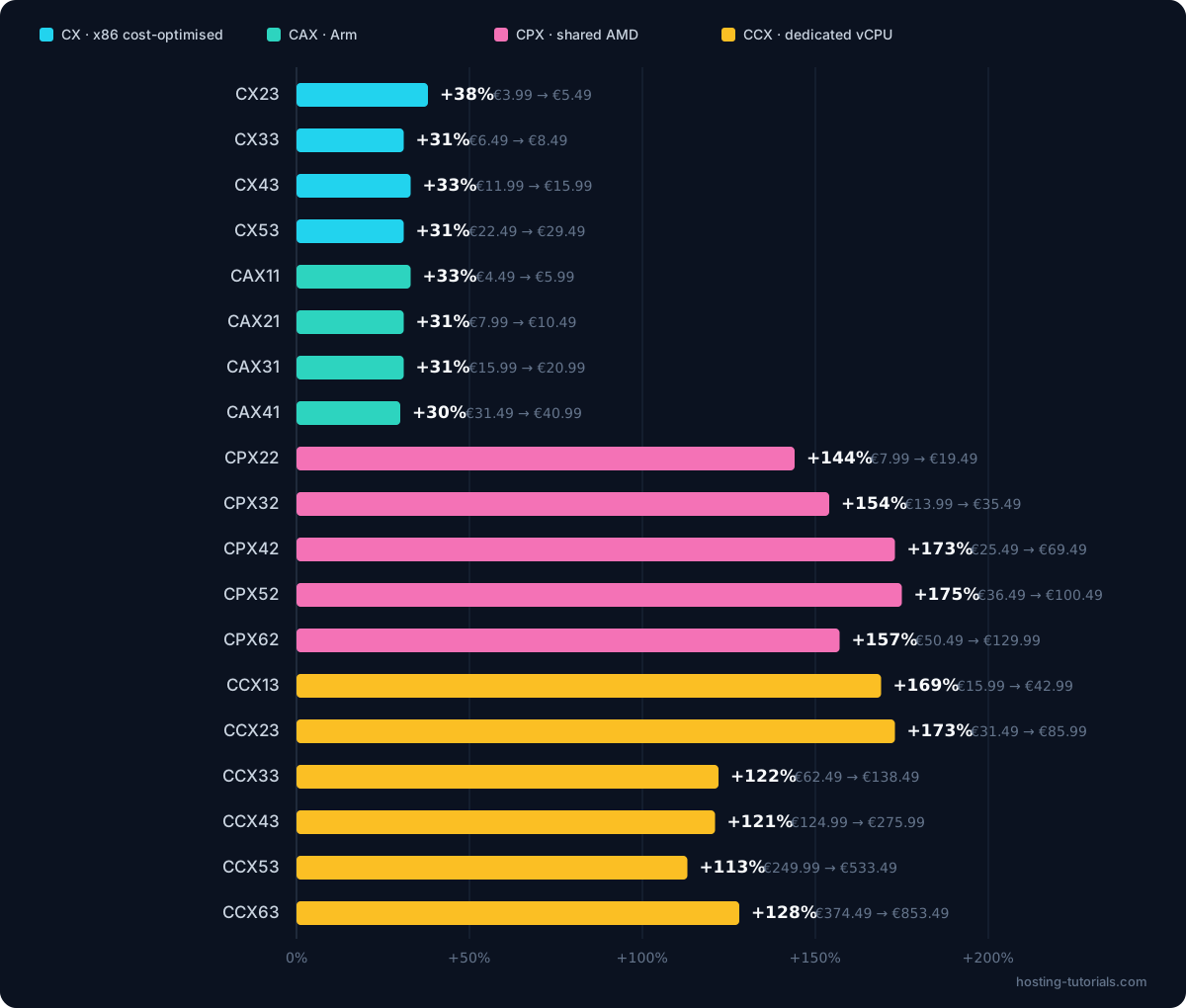
Two clean bands. The cost-optimised lines — CX on x86, CAX on Arm — moved 30% to 38%. Everything else roughly doubled or tripled.
A memory shortage does not explain that shape
If RAM were the whole story, the increase would track the RAM in each plan. It does not.
CX53 and CPX62 both ship 32 GB. One went up 31%, the other 158%. Before June, the CPX cost 2.2 times the CX for the same memory; after, it costs 4.4 times. The two are not identical products — the CPX62 has twice the NVMe and a different shared-CPU class — but no plausible accounting of a doubling in DRAM cost puts that gap where it now sits.
Priced per gigabyte of RAM per month, the plans in the table above now rank like this:
| Line | Cheapest €/GB RAM | Dearest €/GB RAM |
|---|---|---|
| CX (x86, cost-optimised) | 0.92 | 1.37 |
| CAX (Arm, cost-optimised) | 1.28 | 1.50 |
| CPX (shared AMD) | 4.06 | 4.87 |
| CCX (dedicated vCPU) | 4.17 | 5.37 |
The honest reading is that June 2026 was two events wearing one label: a genuine pass-through of component costs, and a repositioning of the product ladder. The cheap lines were held near their old price. The mainstream lines were moved to a new one.
The catch: the cheap line is the one you cannot buy
Held prices only matter if you can order at them. On 28 August 2026 we loaded Hetzner's cost-optimised page and every plan in it — CX23, CX33, CX43, CX53, CAX11, CAX21, CAX31, CAX41, all eight — carried a not available badge. Hetzner says as much on the page itself: the line runs on "proven hardware generations that continue to be used", and "this resource-saving use means that the number of available servers is limited."
So the +31% band is real, and for an existing customer it is what they pay. For someone provisioning a new server this week, the cheapest orderable shared instance is a CPX — the +144% band. The headline increase and the effective increase are different numbers, and only one of them is on the invoice.
Check availability before you plan a migration around a price.
What did not go up at all
The exclusion list in Hetzner's announcement is the most useful paragraph in it. Not affected: "web hosting products, managed servers, servers from the Server Auction, IPs, storage products, Load Balancers, Volumes, Snapshots, and Object Storage."
Which means the relative value of the whole catalogue moved:
- Storage did not reprice. A Storage Box still costs €3.20 a month for 1 TB and €40.60 for 20 TB with unlimited traffic — €2.03 per TB at the top plan. A CPX62 went from €79 to €203 per TB of local NVMe over the same period. The ratio between disk attached to your server and disk on the network went from roughly 39:1 to roughly 100:1 in a single morning.
- The Server Auction did not reprice. We pulled the live auction feed on 28 August 2026: 168 machines, entry price €59 a month, median €81.50, all on 1 Gbit/s with unlimited traffic. The best storage value in the pool was a 12 × 16 TB machine at €404 — €2.05 per raw TB. A plain 2 × 4 TB box sits at €59, or €7.38 per raw TB.
- Shared hosting and managed servers did not reprice. They will eventually — hardware refresh cycles arrive — but this round did not touch them.
The pattern holds beyond Hetzner: the increase concentrated on new compute, and left storage, egress and older inventory where they were. Anything you can move off new RAM, you should.

What to actually do
If you have an existing contract, do nothing. Both providers grandfathered running services. The increase applies to new orders and rescales — which means that resizing a server you already have will reprice it at the new rate. Think twice before a casual rescale.
Check whether you are paying for RAM you do not use. At €4 to €5 per gigabyte per month on the mainstream lines, the 32 GB instance you sized in 2024 is now the largest single lever on the bill. Measure first; a plan one step down often costs 40% less.
Consider Arm. The CAX line took a 30–33% increase rather than 150%, and at €1.28–1.50 per GB of RAM it is the cheapest memory in the catalogue after CX. Most Linux server workloads — web, proxies, queues, CI runners — build for arm64 without incident.
Move bulk data off local NVMe. Object storage and network volumes were excluded from the increase; local NVMe on a compute instance was not. This is now the single biggest arbitrage in the price list.
Look at older hardware. The auction and the "limited" hardware tiers exist precisely because pre-shock machines are still in the racks. They are the last inventory priced in the old world.
If you are shopping on renewal price, read the renewal price. The deepest discounts in this market are 12- and 24-month introductory rates that roughly double at renewal. In a rising-cost year that gap widens rather than narrows.
What comes next
TrendForce's 13–18% forecast for 3Q26 is a deceleration, not a reversal, and it applies to a base that has already risen for four quarters. OVHcloud's own projection runs to the end of 2026. Nothing in either suggests a return to 2025 pricing; the realistic expectation is that the current level is the new floor, and that the next adjustments are smaller.
The useful conclusion is not "hosting got expensive". It is that the shape of the price list changed. Memory is now the scarce thing, disk and bandwidth are not, and the catalogue you memorised in 2024 no longer ranks the way it did. Reprice your own stack against the current list before you renew it.
Prices and availability were read from Hetzner's and OVHcloud's own pages and documentation on 28 August 2026 and will drift. Hetzner figures are euros per month excluding VAT for the German and Finnish locations. Auction figures come from the live auction feed at the same date; raw disk totals are quoted before any RAID.
Sources: Hetzner price adjustment, 15 June 2026 · Hetzner press release · OVHcloud pricing evolution · TrendForce, 3Q26 server DRAM
If you are sizing a machine for bulk storage rather than compute, the arithmetic changes again — we ran it in the best VPS for a seedbox, and in our managed VPS versus shared hosting comparison for the smaller end of the range.