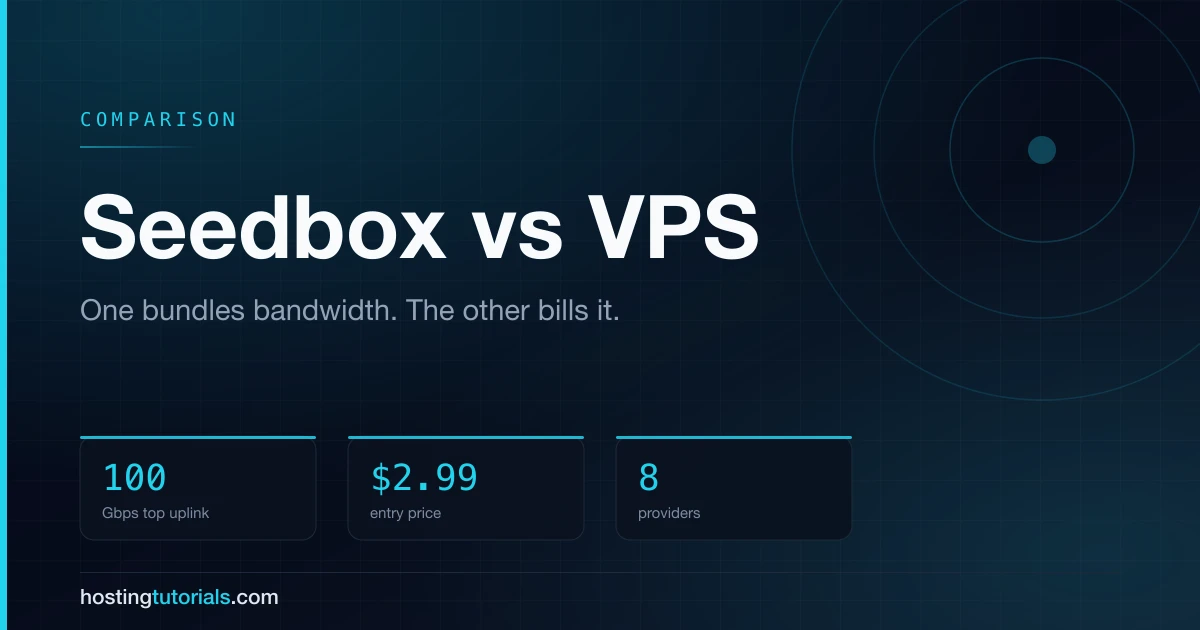
A seedbox and a VPS can look identical on a spec sheet: both are remote Linux machines, both give you disk and bandwidth, both cost between $5 and $30 a month. The difference is not what they are — it is what the network behind them is built to do.
A seedbox sits on a port that is provisioned for sustained outbound saturation. A general-purpose VPS sits on a port that is provisioned for bursty web traffic. That single distinction explains almost every performance surprise people run into when they try to use one as the other.
The short answer
| If you want to… | Pick | Why |
|---|---|---|
| Move large files at line rate, day after day | Seedbox | Ports are sized for sustained transfer, not bursts |
| Run a website, API or database | VPS | You need root, arbitrary ports and a real IP reputation |
| Stream a personal media library | Seedbox | Plex/Emby ship preinstalled and transcoding is accounted for |
| Learn Linux administration | VPS | A seedbox deliberately hides the operating system |
| Keep monthly cost under $10 with 1 TB+ of disk | Seedbox | Storage is the product, so it is priced as the product |
| Host anything that must never share an IP | VPS | Shared seedbox slots share an outbound address |
If you only remember one line: a seedbox is bandwidth-and-disk sold as a product; a VPS is a computer sold as a product.
What actually differs under the hood
Network provisioning is the real gap
This is where the two diverge most and where spec sheets mislead. Both a $10 seedbox and a $10 VPS may advertise "1 Gbps". The seedbox provider expects you to use it continuously. The VPS provider prices on the assumption that you will not.
Typical uplinks on current seedbox plans:
| Provider | Advertised uplink | Entry plan | Storage on entry plan |
|---|---|---|---|
| Whatbox | up to 100 Gbps | $14/mo | 3.9 TB |
| Ultra.cc | up to 50 Gbps | $4.95/mo | 1 TB |
| Seedboxes.cc | up to 50 Gbps | $14.35/mo | 2 TB |
| Feral Hosting | up to 20 Gbps | $10/mo | 1 TB |
| RapidSeedbox | 10 Gbps | $9/mo | 1 TB |
| DediSeedbox | 10 Gbps | $10/mo | 750 GB |
| GigaRapid | 10 Gbps | $2.99/mo | 200 GB |
| Cloudboxes.io | 10 Gbps | $14.95/mo | 1 TB |
| Hosting By Design | 1 Gbps | $14/mo | 1 TB |
A comparable VPS at those prices — a shared-core instance from a mainstream cloud — will typically give you 1 to 2 Gbps burst and a monthly transfer allowance measured in single-digit terabytes.
Read those uplink numbers correctly, though. On a shared seedbox slot, "10 Gbps" is the capacity of the host's port, not a guarantee for your slot. It tells you the ceiling you can occasionally reach and how much headroom exists when neighbours are quiet. It is a useful comparative signal between providers, not a throughput promise. We unpack that in understanding network speed claims.
Bandwidth accounting differs more than bandwidth
Three models are in circulation, and they matter more than the headline speed:
- Unmetered / fair use — DediSeedbox, RapidSeedbox and Feral Hosting sell entry plans on this basis. No counter, but sustained abuse gets throttled or reviewed.
- Metered quota, then throttle — Cloudboxes.io gives 4 TB outbound on its entry plan and drops to 100 Mbit after. Predictable, and cheaper for moderate use.
- Metered quota, then billed — the standard cloud VPS model. Exceeding the allowance costs money rather than speed.
The third model is where people get hurt. Saturating a 1 Gbps VPS port for a single day moves roughly 10 TB. At typical cloud egress rates that is a four-figure bill. Seedbox pricing exists precisely because that workload had to be priced differently.
Storage: capacity versus latency
Seedbox plans lead with capacity because that is what the workload needs. Most entry plans use spinning disks for bulk storage — Whatbox, Ultra.cc and Cloudboxes.io layer NVMe in front as cache — and 1 to 4 TB is normal at the low end.
A VPS at the same price gives you 25 to 80 GB of NVMe. Far faster per operation, and irrelevant if your bottleneck is a 3 TB library.
Control: root access versus a managed appliance
A VPS gives you root. You choose the distribution, the kernel parameters, the firewall, the ports.
A seedbox gives you an account on a machine somebody else administers. You get a control panel, a preinstalled application stack — rTorrent, ruTorrent, Deluge, qBittorrent, Sonarr, Radarr, Plex, Emby, Jellyfin — and no way to break the host. Some providers expose limited shell access; none give you root on a shared slot.
This is a genuine trade, not a limitation to route around. The managed stack is why a seedbox works ten minutes after purchase and why it keeps working after a kernel update you did not have to think about.
IP reputation and isolation
A shared seedbox slot shares an outbound IP with other users. For file transfer this is usually irrelevant, occasionally useful, and occasionally a problem — a neighbour's behaviour can get the address flagged by services you also use.
A VPS gives you a dedicated IP whose reputation is yours alone. If you plan to send email, run an API or expose anything where the address matters, that is not optional.
Dedicated seedbox plans exist and close this gap. RapidSeedbox offers dedicated servers alongside shared slots, at prices that overlap with mid-range VPS instances.


