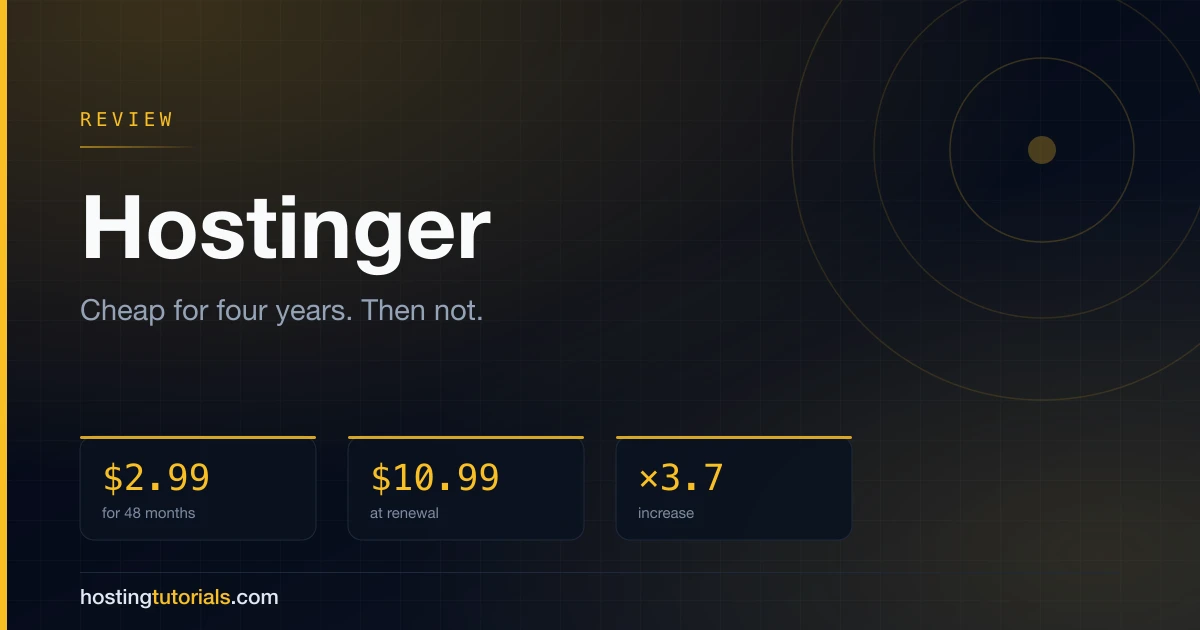
Hostinger is the cheapest credible shared host on the market, and the discount is real. So is the renewal. Understanding how the two relate is most of what you need to decide whether it fits.
What the price actually is
Hostinger's headline rate assumes a four-year prepayment. From its own pricing page:
Two things follow.
The $2.99 requires paying $143.52 up front for four years. On a twelve-month term the effective rate is meaningfully higher. The advertised figure is the best case, not the default.
Renewal is three to four and a half times the intro rate. That is steeper than most of the market. A mid plan bought at $3.79 renews at $16.99 — more than a comparable plan costs at hosts whose intro pricing looked worse.
This is not a hidden cost; Hostinger publishes it. It is a structural feature of the offer: heavily discounted acquisition, full-rate retention. Decide against $10.99–$25.99, and treat the first four years as a discount you happen to get.
What you get for it
LiteSpeed. Hostinger runs LiteSpeed rather than Apache, with LSCache available for WordPress. For a cached WordPress site this is a genuine performance advantage over a stock Apache stack, and it is the main technical reason Hostinger benchmarks well for the price.
hPanel. Its own control panel rather than cPanel — one of the responses to cPanel's per-account licensing. Clean, well organised, and easier for a beginner than cPanel. It is also proprietary, so the familiarity does not travel.
Global datacentres. More location choice than most budget hosts, which matters for latency.
Free domain and SSL on longer terms. Real value, though the domain renews at market rate.
Where it stops working
Resource limits arrive before you expect them. Shared hosting allocates CPU and I/O per account, and Hostinger's entry tiers are tight. A site that grows into real traffic will hit throttling rather than a hard failure — slower responses at peak, which is harder to diagnose than an outage.
No root, no arbitrary services. Standard for shared hosting, and worth stating: if you need a background worker, a non-standard runtime or a custom daemon, you have outgrown the product.
Support is broad rather than deep. Fine for panel questions and routine problems. Less useful for anything requiring someone to reason about your specific stack.
Who it fits
A good fit if you are running one or several small-to-medium WordPress sites, you value price highly, and you are willing to prepay to get the rate. For a first site, a portfolio, a small business brochure site or a blog that is not yet a business, it is hard to beat.
A poor fit if your site is load-bearing for revenue and growing. The point at which shared hosting stops being adequate arrives sooner than most people plan for, and the migration is easier before it becomes urgent. Managed VPS versus shared hosting covers where that line sits.
Verdict
The best value in shared hosting on a four-year term, and a fairly ordinary deal at renewal. LiteSpeed is a real advantage at this price point. hPanel is genuinely good and genuinely proprietary.
Buy it for what it is: cheap, capable hosting for small sites, on a discount that expires. Do not buy it expecting the entry price to be the ongoing price, and do not buy it for a site you expect to grow into serious traffic.
Frequently asked questions
Is Hostinger really $2.99 a month?
On a 48-month prepayment, yes — $143.52 up front. On shorter terms the effective rate is higher, and it renews at $10.99.
Is Hostinger fast?
For cached WordPress on LiteSpeed, yes, and unusually so for the price. Under sustained traffic on an entry plan you will meet the resource limits before you meet the server's limits.
Is hPanel as good as cPanel?
For most tasks, better — cleaner and easier to learn. The trade is portability: hPanel only exists at Hostinger. The same argument applies to SPanel at ScalaHosting.
Can I run a shop on it?
A small one, yes. As order volume and catalogue size grow, the resource limits become the constraint. Plan the move before conversion rates start reflecting response times.
What happens at renewal?
You pay the published renewal rate. Hostinger states it clearly at purchase; the mistake is budgeting from the promotional figure.
Some links on this page are affiliate links. If you sign up through them we may earn a commission, at no extra cost to you. It never changes which providers we recommend or how we rank them.