A small business buying hosting is not making the same purchase as a hobbyist. The site is load-bearing: it takes enquiries, bookings or orders, and an afternoon of slow pages costs real money. That changes which trade-offs are acceptable.
Three things follow, and they are not the ones in most comparison tables.
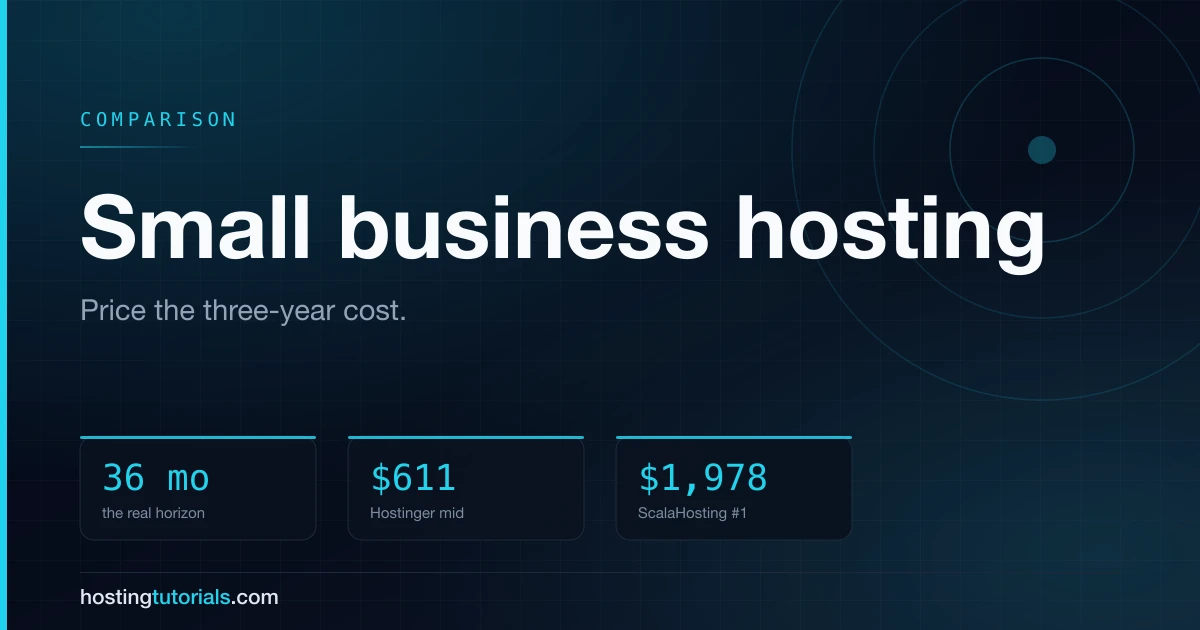
Price the three-year cost, not the monthly rate
Hosting is sold on an introductory rate and renewed at a materially higher one. For a business that will still exist in three years, the renewal price is the price.
The ranking by advertised price and the ranking by three-year cost are not the same ranking. Build the comparison on the second one.
Decide what an hour of downtime costs you
This single number determines how much reliability is worth buying, and most small businesses have never calculated it.
Take monthly revenue attributable to the site, divide by the hours you actually trade. A business doing €20,000 a month over roughly 200 trading hours loses about €100 an hour when the site is down — and more than that when it is merely slow, because slow pages lose conversions silently and without an alert.
If that number is meaningful, the calculation changes:
- Paying $20 a month more for a host with real support stops being an expense and becomes cheap insurance
- Shared hosting's throttling behaviour — slow afternoons rather than outages — becomes a genuine business risk, because it costs you money without triggering any alarm
- An independent backup you control becomes non-negotiable
If the number is small, keep the cheap plan. Not every business site is a revenue channel.
Buy support you can actually reach
For a small business without in-house technical staff, support quality is the feature that matters most and the hardest to evaluate before buying.
The distinction to test: will they look at your specific problem, or only answer questions about the panel? Budget hosts do the second. Mid-tier hosts do the first, and the price gap between them is usually smaller than one incident.
A practical test before committing: open a pre-sales ticket with a moderately technical question about your actual stack. The quality and speed of that answer is a reasonable proxy for what you will get as a customer — and pre-sales support is usually the best support a host offers, so treat it as the ceiling.
What to buy, by situation
Brochure site, enquiries by phone and email.
Shared hosting, mid-tier, twelve-month term. Hostinger at the renewal price is fine. Add an independent backup. Do not overbuy.
Bookings or a small shop, revenue through the site.
The upper shared tier or an entry managed VPS. Carts and logged-in sessions cannot be cached, which is exactly where shared hosting's resource allocation binds. Prioritise support quality over specifications.
Several sites, or client sites you manage.
Managed VPS. ScalaHosting bundles SPanel, so the panel cost does not scale with the number of accounts — the main economic argument, provided the renewal price works. If you are comfortable administering servers, Vultr costs considerably less and costs you time instead.
Developer on staff, or you build things yourself.
Unmanaged VPS. You will get more machine for the money and the maintenance is work you can absorb.
The three things people skip
Your own backup. Host backups protect against most incidents but not against losing the account — a billing lapse, an expired card, a terms dispute. Keep one copy somewhere the host does not control. The reasoning in full.
Domain registered separately from hosting. Costs nothing extra, and it is the difference between changing host in an afternoon and being stuck.
A tested restore. Not a backup — a restore you have actually performed once, with the elapsed time written down. That number is your real recovery time and it is always longer than assumed.
Frequently asked questions
Is shared hosting good enough for a business?
For a brochure site, yes. For anything transactional and growing, the resource allocation becomes the constraint sooner than most plans anticipate.
How much should a small business spend on hosting?
Anchored on what downtime costs, not on a benchmark. If an hour offline costs €100, arguing over $15 a month is the wrong optimisation.
Managed or unmanaged?
Unmanaged only if someone on the team is comfortable administering a Linux server and has time to keep doing it. Otherwise managed, and treat the difference as a staff cost you are not paying.
Do I need a VPS for a shop?
Not necessarily at the start. A small catalogue on a good shared plan works. The signal to move is uncacheable pages under concurrency — that is when shared hosting starts costing you conversions.
What about managed WordPress?
A reasonable middle option for a single WordPress site that has outgrown shared hosting: more than shared, less than a VPS, and it removes the server question entirely.
Some links on this page are affiliate links. If you sign up through them we may earn a commission, at no extra cost to you. It never changes which providers we recommend or how we rank them.